

How Our Thermal Break Aluminum Windows Meet Strict Passive House Standards
As a senior product engineer at Tryba, I frequently consult with North American architects and commercial builders who are pushing the boundaries of energy efficiency. One of the most demanding certifications in the industry today is the Passive House standard. When designing our recent Canada Passive House project, we had to ensure our fenestration systems could withstand freezing winters while maintaining near-zero energy loss. Today, I will explain the engineering behind how a highly customized thermal break aluminum window achieves these rigorous requirements.
At our 10,000+ square meter factory, we do not just manufacture windows; we engineer comprehensive building envelope solutions. Let us dive into the technical details.
Core Guide
The Passive House Challenge: Understanding U-Factor and SHGC.
Polyamide Thermal Struts: Eliminating the thermal bridge.
Advanced IGUs: The science of multi-pane glazing.
Airtightness: Why continuous weatherstripping is non-negotiable.
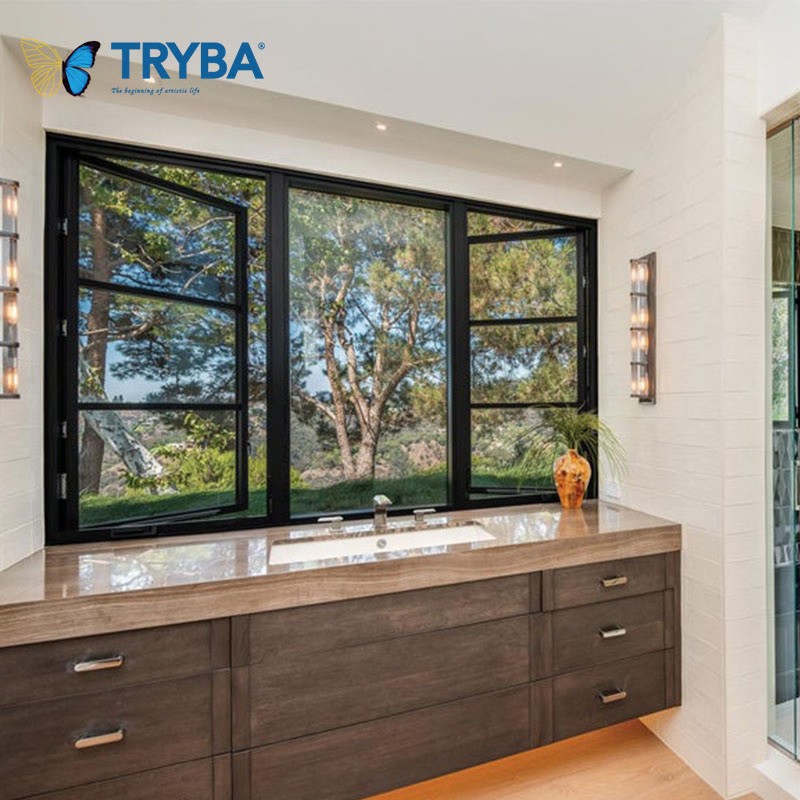
1. The Passive House Challenge: U-Factor and Energy Efficiency
To qualify for Passive House certification in extreme climates like Canada or the northern US, the building envelope must be exceptionally insulated. For fenestration products, this means achieving an extremely low U-Factor (thermal transmittance) and a perfectly balanced Solar Heat Gain Coefficient (SHGC).
Standard aluminum extrusions are highly conductive, meaning they easily transfer heat from the inside out during winter, and from the outside in during summer. To overcome this, commercial builders must upgrade to advanced architectural systems designed specifically for thermal isolation.
2. Polyamide Thermal Struts: Breaking the Sound and Thermal Bridge
The secret to our high-specification fenestration lies in the core of the frame. To prevent heat transfer, we integrate wide, non-metallic polyamide thermal struts between the interior and exterior aluminum profiles.
This "thermal break" completely interrupts the conductive path of the metal. Not only does this drastically reduce the U-Factor, but it also maximizes Condensation Resistance (CR)—a critical factor in cold climates to prevent mold and interior drywall damage. By utilizing this technology, our broken bridge aluminum doors and windows deliver the structural durability of commercial aluminum with the insulation properties typically reserved for premium timber or UPVC.
3. Custom IGUs for Supreme Thermal Performance
A window is predominantly glass, making the glazing configuration vital for Passive House approval. Tryba’s architectural systems are engineered with deep glazing pockets to accommodate triple-pane Insulating Glass Units (IGUs).
By filling the cavities between the glass panes with dense inert gases (like Argon or Krypton) and applying specialized Low-E (low-emissivity) coatings, we create an impenetrable barrier against heat loss. This setup also significantly reduces HVAC cooling loads during the summer, ensuring year-round comfort and massive energy savings.
4. Airtightness: The Role of Continuous Weatherstripping
A Passive House is famously airtight. Even a microscopic gap in the window sash can cause air infiltration, ruining the building's energy efficiency.
To guarantee perfect airtightness, our tilt and turn systems utilize heavy-duty European multi-point locking hardware. When the handle is engaged, it pulls the entire sash tightly against our highly elastic, continuous compression weatherstripping. This creates a hermetic seal that completely blocks out drafts, water penetration, and even high-frequency street noise.
Elevate Your Next Project with Tryba
With over 100 skilled production workers and decades of German manufacturing processes, Tryba focuses on mid-to-high-end home improvement and commercial projects. We understand that North American architects and builders cannot compromise on building codes or energy efficiency.
Are you looking for certified, high-performance fenestration products that meet Passive House standards? Contact our engineering experts online today to discuss your blueprints and get a free customized quote
Connect With Our Experts
Online Message

Online Message
Please feel free to inquiry us we will answer you soon